




























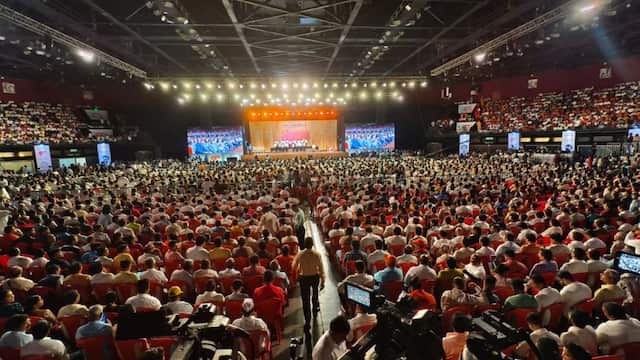
After two decades, estranged cousins Raj and Uddhav Thackeray reunited in Mumbai on Saturday for a “mega victory gathering” to celebrate the Maharashtra government’s rollback of its controversial Hindi language policy in primary schools.
The joint rally, currently underway at the NSCI Dome in Worli, marks a significant political moment as Shiv Sena (UBT) chief Uddhav Thackeray and Maharashtra Navnirman Sena (MNS) president Raj Thackeray share a public platform ahead of the upcoming local body polls—potentially hinting at a new political alignment in the state.
While the rally has drawn wide public attention and participation from prominent personalities across various fields—Marathi literary figures, educators, editors, and artists—key opposition allies such as NCP founder Sharad Pawar and Congress leader Harshavardhan Sapkal are notably absent. MNS sources indicated Sapkal could not be contacted.
The Congress has chosen to distance itself from the Thackeray brothers’ show of strength, despite its opposition to the state’s language policy. Party leaders cited concerns about alienating the non-Marathi voter base ahead of the Brihanmumbai Municipal Corporation elections.
The Maharashtra education department had earlier proposed making Hindi a compulsory third language for Classes 1 to 5 in both Marathi and English medium schools, as per the National Education Policy (NEP) 2020. A government resolution to this effect was issued on April 17.
Amid opposition pressure, the policy was modified on June 18, stating Hindi would be the default third language, with students allowed to choose another Indian language if at least 20 students in a class requested it. A review committee was then formed on June 24 to reassess the decision.
Following widespread criticism from the Maha Vikas Aghadi alliance—including Shiv Sena (UBT), MNS, and NCP (SP)—the state government rescinded both resolutions last Sunday.
Chief Minister Devendra Fadnavis has since announced the formation of a committee, headed by educationist Dr Narendra Jadhav, to recommend when and how additional languages should be introduced, and to provide clarity on available options for students.